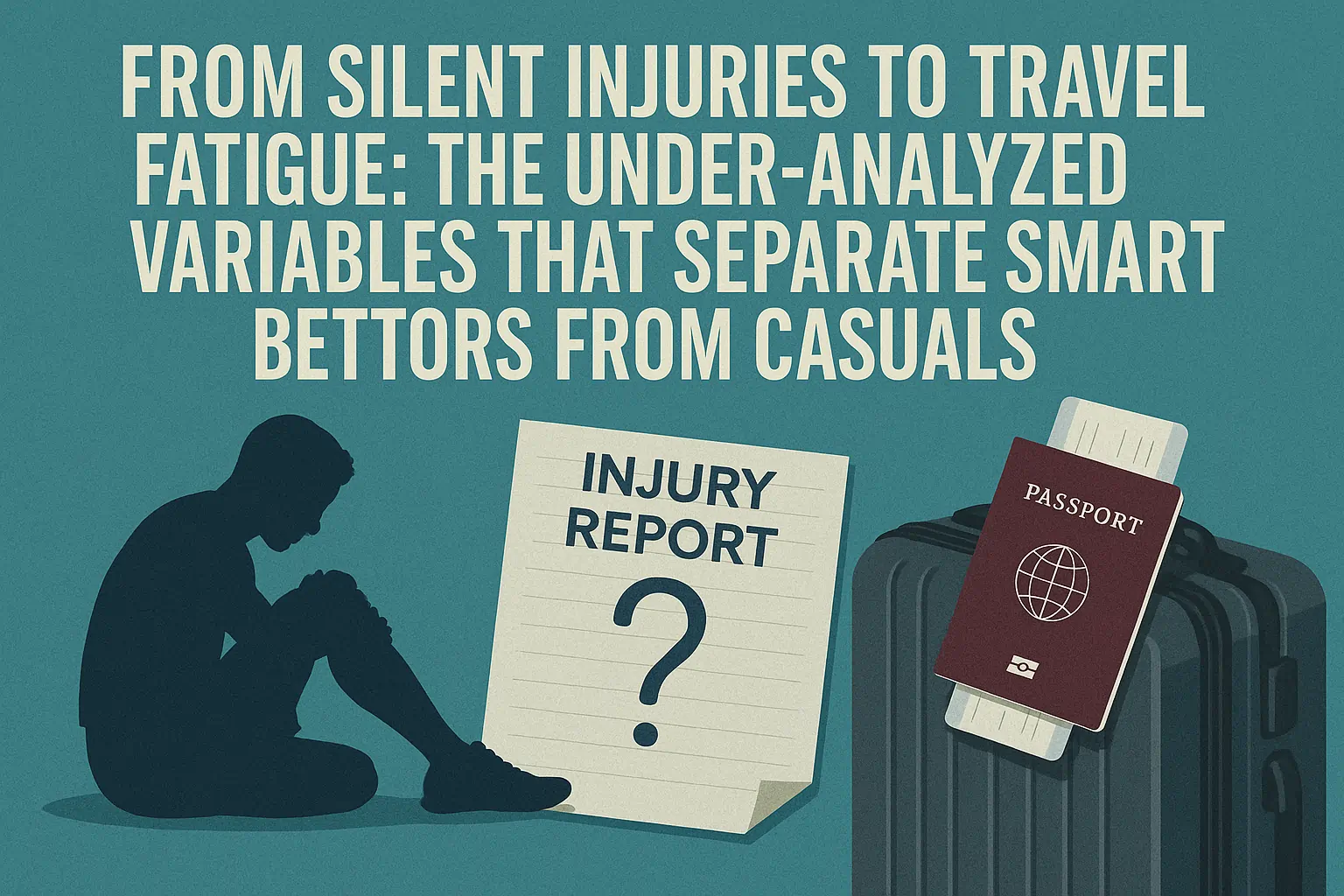
There’s a reason so many bettors feel like they’re always half a step behind. They study the same numbers everyone else studies, look at the same matchups, pull the same injury reports — and then wonder why the market seems to move faster than they do. The truth is simple and a little uncomfortable: the stuff that actually shifts a game often never shows up in the places casual bettors rely on. It shows up in bodies, in travel slumps, in the strange emotional dips teams fall into when nobody’s paying attention.
If you’ve been around enough locker rooms or caught enough games in the press box, you start realizing the season isn’t designed for rest or clarity – it’s more like a treadmill that keeps speeding up. And if you’re betting without reading those little signals that players give off when the grind hits them, you’re basically leaving the most valuable part of the picture outside the frame.
The Injuries Nobody Talks About but Everyone Plays Through
Teams don’t disclose information. They never have. Unless a player is legitimately out, what they’re dealing with is usually buried under clichés about “maintenance” or “tightness” or “we’ll see how he feels.” You figure out what’s real by watching the player move. A guy who usually explodes off his left foot suddenly drives less. A guard who lives at the rim starts settling for mid-range pull-ups. A winger avoids board battles he normally welcomes.
You can miss it if you’re not looking directly at it. Most bettors do miss it — they glance at the injury line, see nothing alarming, and move on. Sharper bettors don’t wait for a report; they trust what the eye test tells them long before the league or coach acknowledges anything. Even places like CryptoManiaks, when they write about risk-taking and performance swings, talk about how much unreported physical wear shapes outcomes in ways models rarely quantify.
These tiny injuries don’t knock players out. They just make them 80% of who they were yesterday. That 20% gap is where the edge hides.
Travel Schedules That Drain Teams Long Before Anyone Notices
Travel doesn’t just move teams from point A to point B. It strips away sharpness. Back-to-backs across time zones, late flights, early tip-offs — those hit harder than the betting market likes to admit. You notice it right away — the legs aren’t there. Transition looks sluggish, closeouts come late, and the whole defense feels a little loose. A team that slept on a plane carries that fog straight onto the floor. Coaches don’t need a metric for that — they sense it almost instantly. They start burning timeouts early, tightening rotations, hiding certain matchups just to avoid letting fatigue turn into a landslide. Bettors who watch closely pick up on it long before the books do.
The Emotional Weight That Never Makes It Into the Box Score
Every team hits emotional turbulence. A bad loss, a public spat, a blown lead, back-to-back overtime games — these things stick in the air even after everyone swears they’ve “moved on.” And it changes how players behave. You see more hesitation, more frustration fouls, more possessions where nobody wants the ball.
Bettors, like anyone else, trust their instincts first. But when things stop lining up, they look around for clues — the same way people skim through crypto casino reviews when something about a platform feels slightly off. Maybe the RTP numbers don’t line up with what players are actually seeing. Then the withdrawal queue starts to drag, and the bonus rules get tweaked in ways nobody explains. Those are the little tells that a crypto casino is feeling strain on the inside, whether it’s liquidity, risk, or simple mismanagement. If you’ve hung around these platforms long enough, you recognize that pattern before anyone says a word. Sports are no different: a few broken sets, a pause before a pass, guys drifting out of a play, and you can tell the team isn’t really in sync, no matter what the box score says. They’re not hunting for shortcuts, but trying to understand a vibe. Teams feel that same internal shift after rough stretches. You walk into the locker room, and the energy’s different. Players get tight. Plays slow down. The whole group moves like they’re carrying something they haven’t shaken off yet.
No model explains that kind of emotional drag. But if you watch enough games, you know it the moment you see it.
How Sharps Spot Fatigue Before Oddsmakers Do
There’s usually a tell. Sometimes several. And they show up long before the market reacts.
- Slow defensive rotations early in games
- Players giving up the ball sooner than usual, avoiding pressure spots
- Coaches using quick timeouts to shake a sluggish start
- Fewer transition attempts from teams that usually push pace
- Sagging body language after neutral plays, not just bad ones
- Rotations that tighten out of nowhere, hiding tired legs
None of these screams “bet this now,” but stack the signals together, and you get a clear picture of a team that’s not itself. That’s when sharp bettors step in. And it’s also where the cracks show up fastest in prop bets. A player battling something small doesn’t rebound, sprint, or cut the same way, but the line still treats him like he will. Those tiny delays in pricing are gold.
The Market Moves Slowly — Humans Don’t
Oddsmakers aren’t blind. They’re just cautious. They need confirmation before shifting a spread, because money flies the second something looks off. So lines move gradually, even when a player clearly isn’t right. By the time the update becomes official, sharp bettors have been acting on it for hours — sometimes days.
Watching the game itself always beats reading a report. You see problems immediately: a star avoiding contact, a defense line that looks like it slept three hours, a team that plays like it wants the night to end as soon as possible. The numbers catch up later.
There’s always a moment when the game tells you something the odds haven’t caught up to yet. That’s the window the smart bettors crawl through.
Why the Edge Keeps Sliding Toward the Sharps
These days, everyone’s got the same stats at their fingertips. Everyone sees efficiency charts, matchup breakdowns, advanced metrics. That used to be an edge; now it’s the baseline. So the real advantage moved elsewhere — into the realm of fatigue, psychology, tiny injuries, travel drag, and yes, simple human behavior.
Casual bettors still act like each game exists in a vacuum. Sharps treat every game like a continuation of whatever happened yesterday, last week, last month. The season leaves footprints if you know where to look. Most people don’t bother looking.
Conclusion
Most losing bets aren’t bad ideas. They’re blind spots. The tired legs nobody mentioned. The drained team coming off a brutal road stretch. The star with a “nothing injury” that turns out to be something. The emotional hangover the box score can’t show.
If you can catch those things before the line moves — and you usually can if you watch closely — you’re not outsmarting the market. You’re just paying attention to what everyone else missed. And in a betting world where the numbers are the same for everybody, that’s the only edge that never really goes away.